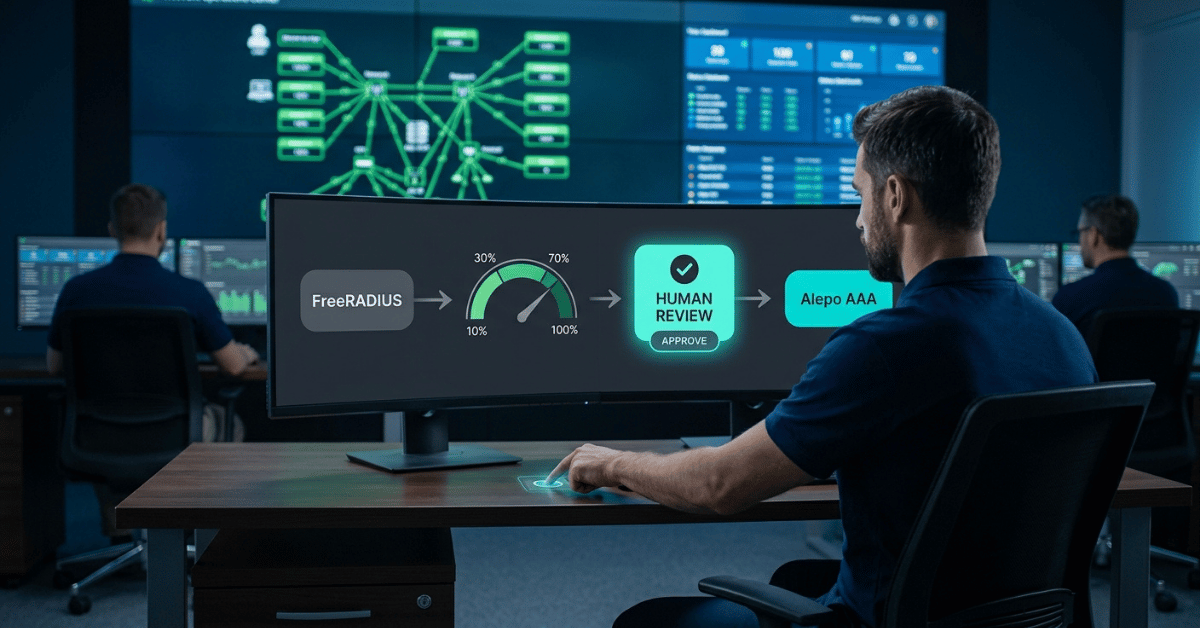
As telecom networks grow more complex driven by 5G rollouts, expanding IoT ecosystems, and surging subscriber volumes network optimization can no longer rely on static configurations and reactive fixes. Operators need systems that think, adapt, and act in real time. That is exactly what native AI embedded in a carrier-grade AAA (Authentication, Authorization, and Accounting) server delivers.
Unlike bolt-on AI tools layered on top of legacy systems, native AI is architected directly into the AAA core making intelligence an intrinsic part of every authentication, policy enforcement, and accounting decision. The result is a fundamentally smarter network.
What Does “Native AI” in AAA Actually Mean?
Native AI in AAA means machine learning and intelligent automation are built into the platform’s architecture from the ground up not added as an afterthought. Every subscriber session, every policy decision, and every network event feeds an AI engine that continuously learns and optimizes.
This is a significant departure from traditional AAA systems, which rely on manually defined rules that require constant updates to stay relevant. Native AI removes that dependency. The system evolves with the network, autonomously refining its responses as traffic patterns shift, subscriber behaviors change, and new services are introduced.
Real-Time, Intelligent Policy Management
One of the most impactful applications of native AI in carrier-grade AAA is real-time policy management. Traditional AAA servers enforce policies based on pre-configured rules. AI changes this paradigm by enabling dynamic, context-aware policy enforcement at sub-millisecond speeds.
With AI-driven policy management, the AAA server can detect congestion signals, subscriber usage patterns, and service quality metrics simultaneously and adjust policies on the fly. Bandwidth-on-demand, mid-session policy changes, and tiered QoS enforcement become automated and precise. Operators gain the ability to monetize network resources more intelligently, delivering a superior customer experience without manual intervention.
Predictive Network Optimization
Reactive optimization is no longer sufficient for carrier-grade operations. Native AI enables predictive optimization anticipating network stress points before they impact performance.
By continuously analyzing historical traffic data and real-time telemetry, the AI-powered AAA identifies load trends, predicts congestion windows, and proactively redistributes session traffic. This predictive capability ensures consistent five-nines (99.999%) availability, even during peak demand periods. Operators benefit from fewer service disruptions, reduced operational overhead, and a network that scales intelligently as subscriber bases grow.
Also Read: How AI-Native Telcos Will Outpace Traditional Operators in 2026 and Beyond
Automated Anomaly Detection and Security
Security in telecom networks is a constant battle. AAA signaling noise caused by repeated authentication failures, rogue devices, and coordinated attacks degrades network performance and creates vulnerability windows.
Native AI transforms the AAA into an intelligent security layer. Machine learning models trained on network behavior can distinguish legitimate traffic from anomalous patterns in real time, automatically isolating and mitigating threats before they escalate. Fraudulent access attempts, DDoS patterns, and unauthorized session hijacking are detected and neutralized with minimal human involvement. This adaptive security posture is a critical advantage as networks extend to 5G and IoT environments, where the attack surface expands significantly.
Why Native AI Outperforms Bolt-On Approaches
Operators who have integrated third-party AI tools onto legacy AAA platforms consistently encounter the same limitations: latency introduced by data handoffs, integration complexity, and AI models that are disconnected from core network telemetry.
Native AI eliminates these gaps. When intelligence is embedded in the AAA core, decisions are made where the data originates with zero latency overhead. The AI has direct access to authentication events, session states, and policy contexts, enabling a depth of optimization that external tools simply cannot achieve.
How Alepo Delivers Native AI in Carrier-Grade AAA
Alepo’s carrier-grade AAA is purpose-built for the demands of modern telecom networks. Its architecture supports AI-driven policy management, automated anomaly detection, and real-time performance optimization all natively embedded. With an industry-leading benchmark of 36,000 transactions per second, stateless design for five-nines availability, and seamless integration via API gateway, Alepo’s AAA empowers operators to harness the full potential of native AI without disrupting existing systems or integrations.
As networks evolve toward 5G and beyond, the question is no longer whether AI belongs in AAA, it is whether your AAA is built to make AI native.
Ready to explore how Alepo’s AI-powered AAA can optimize your network? Book a demo today.